


Celestial Charts
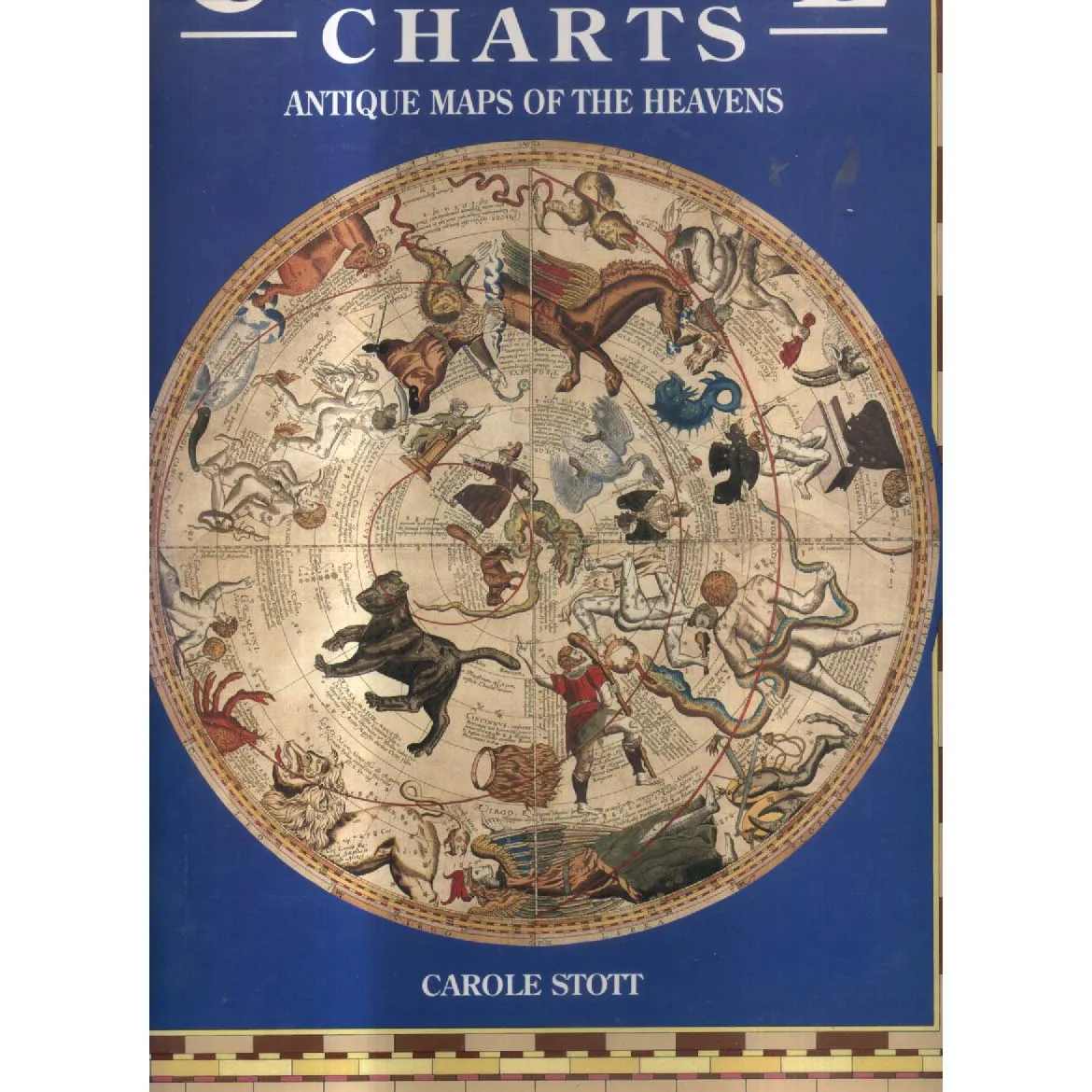
Publisher: Studio Editions
Format: Hardback
ISBN: 9781851706266
Celestial Charts (1991) – Carole Stott
Studio Editions | ISBN: 9781851706266
Condition: Very Good | Sold by Crappy Old Books
The universe. An unimaginably vast collection of stars, planets, galaxies and assorted cosmic phenomena, spread across distances so enormous that even the most ambitious estate agent would struggle to describe them as conveniently located. For thousands of years, humanity has gazed upwards, attempting to make sense of the heavens, chart the movements of celestial bodies and determine whether the peculiar arrangement of stars overhead might offer some explanation for events down here.
Welcome to Celestial Charts, Carole Stott’s fascinating exploration of the art and science of mapping the heavens, celebrating the extraordinary ingenuity with which astronomers, cartographers and celestial observers have attempted to impose a little order upon infinity.
Long before powerful telescopes, orbiting observatories and computer-generated star maps, astronomers relied upon painstaking observations, mathematical calculations and considerable patience to record the positions of heavenly bodies.
The resulting celestial charts were often magnificent works of art as well as scientific instruments. Constellations became elaborate figures drawn from classical mythology, with heroic warriors, fearsome beasts and unfortunate individuals immortalised among the stars, frequently as a consequence of behaving rather badly in a Greek legend.
To the modern observer, these arrangements can appear wonderfully imaginative. Where one person sees a collection of distant points of light, the ancient astronomer apparently sees a winged horse, a hunting dog or an exceptionally complicated sea monster.
One suspects that imagination was considered an essential qualification for the profession.
Yet beneath the decorative splendour lay serious scientific endeavour. Celestial charts played an important role in navigation, astronomical study and humanity’s developing understanding of its place within the cosmos.
For sailors crossing unfamiliar oceans, the stars provided essential guidance. For astronomers, the careful recording of celestial positions helped establish patterns, identify movements and challenge long-established assumptions about the structure of the universe.
The history of celestial cartography also reflects the changing relationship between science, religion, mythology and artistic expression. As astronomical knowledge advanced, increasingly accurate observations transformed the representation of the heavens, while older traditions continued to influence the names and imagery associated with the constellations.
Carole Stott, an established astronomy writer, brings an appreciation of both the scientific significance and visual appeal of these remarkable representations of the night sky.
Published by Studio Editions in 1991, this volume offers an attractive subject for anyone interested in the intersection of astronomy, history, cartography and the decorative arts.
There is something particularly delightful about celestial maps. Ordinary maps tell us where we are going, while celestial charts remind us how spectacularly insignificant our destination is when compared with the rest of the universe.
This 1991 Studio Editions edition, offered in Very Good condition by Crappy Old Books, is an appealing acquisition for astronomy enthusiasts, collectors of historical maps, lovers of scientific illustration and anyone fascinated by humanity’s centuries-long attempt to understand the heavens.
A captivating celebration of the beauty, ambition and intellectual achievement involved in charting the stars.
Because mankind has always possessed an irresistible desire to put everything on a map.
Even when the territory in question is several billion light-years across.
And the chances of finding a convenient parking space are practically nonexistent.
Keep browsing: See more Space books Other books by Carole Stott
